Check rendered storefront pages
Scan the experience customers actually receive, regardless of the commerce platform behind it.
Start with product, basket, checkout, and account pages. Fix what automation can prove, then use the manual checklist for what needs human judgement.
Scan the experience customers actually receive, regardless of the commerce platform behind it.
Group issues by severity and page so teams can start with forms, controls, names, contrast, and navigation.
Re-scan after theme or checkout changes and keep an accessibility statement aligned with current evidence.
Cart, checkout, login, and payment are connected customer jobs. Treat them as one testable journey while keeping the automation boundary visible.
Check product options, quantity controls, update messages, names, focus order, and rendered errors.
Scan reachable checkout states and record guided keyboard, reflow, label, and error-prevention checks.
Use a dedicated saved test account for configured authenticated scans and repeatable journeys.
Review the rendered transition and return states; third-party payment behavior still needs human testing.
Rendered markup, accessible names, labels, contrast, structure, selected-rule regressions, and reached-page evidence.
Keyboard flow, understandable errors, content meaning, assistive-technology behavior, and third-party payment states.
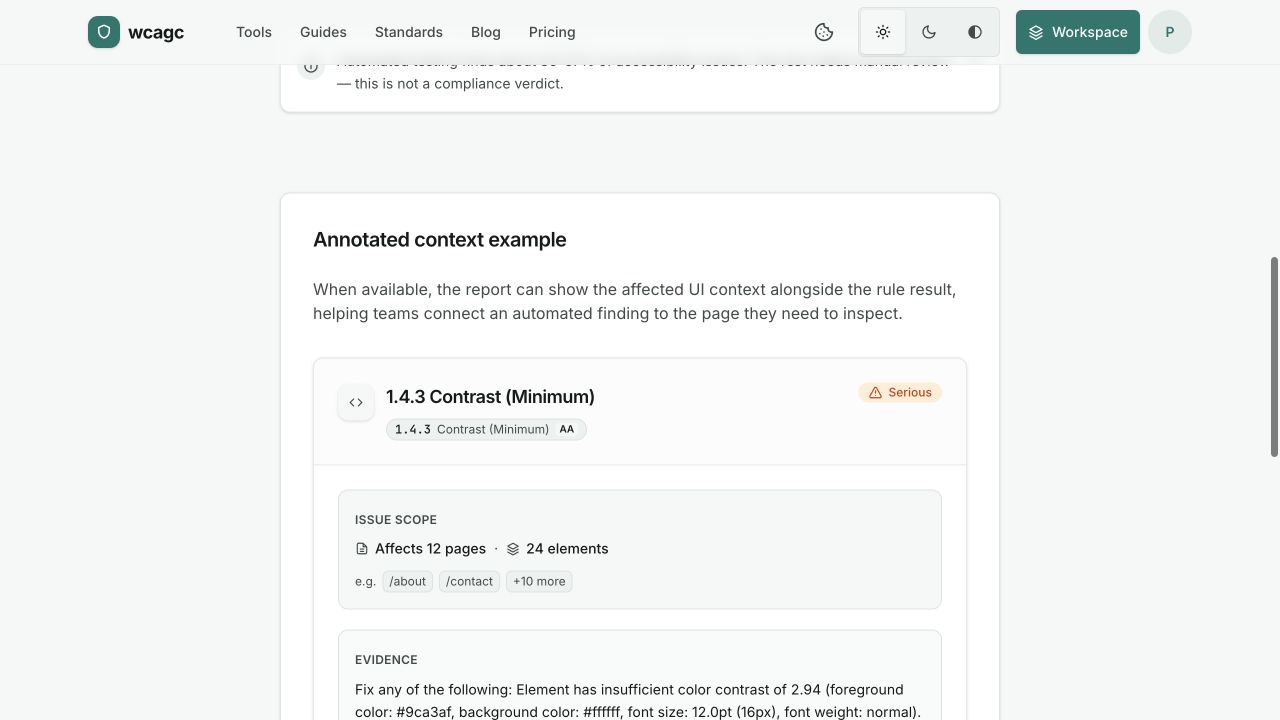
The sample is a real report view: severity, affected element, rule, and a practical direction for the fix. Automated coverage is clearly separated from manual review.